Australian import duty rates: the complete 2026 guide
Bruce·20 Nov 2025·7 min read
Australian import duty is a tax applied to goods entering the country, calculated as a percentage of their customs value. The Australian Border Force (ABF) collects duty based on how goods are classified under the Harmonised System (HS), a global product classification with about 11,500 line items in the Australian tariff schedule. General rates range from 0% to 10% for most goods, though some attract anti-dumping or countervailing duties on top. If your goods qualify under one of Australia's 17 Free Trade Agreements, the rate may be reduced or zero.
This guide covers the actual rates you'll encounter in 2026, by product category, with the FTA rates that apply to Australia's biggest trading partners.
How duty rates work
Australia's tariff schedule is divided into 97 chapters, grouped into 21 sections. Chapter 1 covers live animals. Chapter 97 covers works of art. Everything else falls somewhere in between. Each chapter contains headings (4 digits) and subheadings (6, 8, or 10 digits) that describe products in increasingly specific detail. A "laptop computer" isn't classified as "electronics" in some general sense. It's classified under heading 8471.30, which specifies portable automatic data processing machines weighing not more than 10 kg.
The duty rate attached to each subheading comes in three flavours. Most are ad valorem, meaning a percentage of the customs value, like 5% of CIF value. Some are specific, meaning a fixed amount per unit, like $1.22 per litre of wine. A handful are compound rates, combining both, though these are rare in the Australian schedule.
Every subheading has a general rate (applying to all countries) and then preferential rates for FTA partner countries. The general rate for clothing is 5%. But if you're importing from New Zealand under ANZCERTA, the rate is 0%. If you're importing from China under ChAFTA, it's also 0% for most textile products. The full Australian tariff schedule lists all rates by subheading, including every FTA concession.
Common duty rates by product category
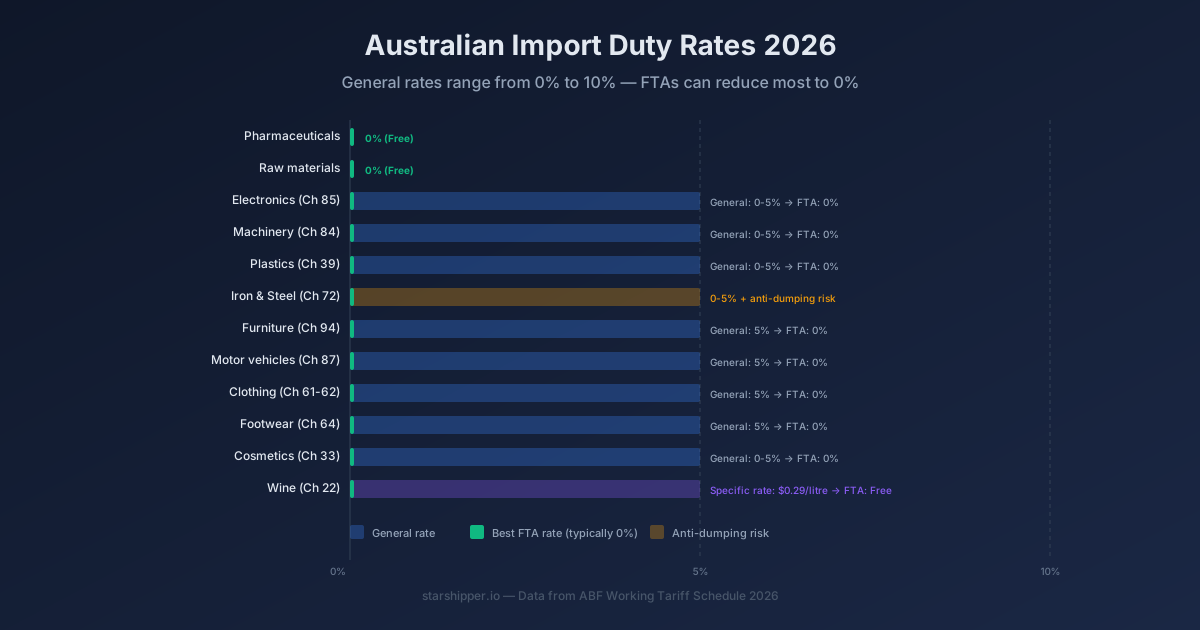
The table below covers the most commonly imported product categories. The "General Rate" is what you pay if there's no FTA preference. The "Best FTA Rate" column shows the lowest available rate under any current agreement, though you'll need a valid certificate of origin to claim it.
| Product Category | HS Chapters | General Rate | Best FTA Rate | Notes |
|---|---|---|---|---|
| Pharmaceuticals | Ch 30 | 0% | 0% | Free under all tariff lines |
| Medical instruments | Ch 90 | 0–5% | 0% | Most diagnostic/surgical instruments free |
| Raw materials (ores, minerals) | Ch 25–26 | 0% | 0% | Almost universally free |
| Organic chemicals | Ch 29 | 0–5% | 0% | Most industrial chemicals free |
| Plastics & articles | Ch 39 | 0–5% | 0% | Raw resins 0%, finished articles 5% |
| Paper & paperboard | Ch 48 | 0–5% | 0% | Newsprint 0%, coated paper 5% |
| Iron & steel | Ch 72 | 0–5% | 0% | Check for anti-dumping measures |
| Aluminium & articles | Ch 76 | 0–5% | 0% | Anti-dumping duties may apply |
| Machinery & equipment | Ch 84 | 0–5% | 0% | Industrial machinery often 0%, consumer appliances 5% |
| Electronics & electrical | Ch 85 | 0–5% | 0% | Computers, phones, semiconductors 0%; consumer goods 5% |
| Motor vehicles | Ch 87 | 5% | 0% | Passenger vehicles 5% general; 0% under US, Korea, Japan FTAs |
| Clothing (knitted) | Ch 61 | 5% | 0% | 0% under ChAFTA, AANZFTA, KAFTA |
| Clothing (woven) | Ch 62 | 5% | 0% | Same FTA concessions as knitted |
| Footwear | Ch 64 | 5% | 0% | Leather and textile footwear both 5% general |
| Furniture | Ch 94 | 5% | 0% | Includes mattresses, lighting, prefab buildings |
| Toys & games | Ch 95 | 0–5% | 0% | Many toys 0%, some sporting goods 5% |
| Cosmetics & perfumery | Ch 33 | 0–5% | 0% | Essential oils 0%, makeup and skincare 5% |
| Wine | Ch 22 | $1.22/litre | $0/litre | Specific rate, not percentage; 0% under NZ, Chile FTAs |
| Spirits | Ch 22 | $95.84/litre of alcohol | Varies | Excise applies separately; high specific rates |
| Tobacco | Ch 24 | 5% + excise | 5% | Excise is the major cost component, not duty |
A few things to note. The 0% "Best FTA Rate" for most categories reflects the maturity of Australia's trade agreements. ChAFTA (China), JAEPA (Japan), KAFTA (Korea), and AANZFTA (ASEAN) have eliminated duty on a wide range of goods. But qualifying for 0% requires proof of origin, which means either a certificate of origin issued by an authorised body, or a self-declaration meeting the rules of origin for that specific agreement. If you can't prove origin, you pay the general rate.
For a deeper dive into how each FTA works and what qualifies, see our guide to Australian Free Trade Agreements.
Duty-free imports
Not everything attracts duty, even without an FTA.
Goods with a customs value (FOB) of $1,000 or less are exempt from duty and GST under the de minimis threshold. This applies to commercial and personal imports alike. Above $1,000, you need a formal import declaration (N10) and you'll pay whatever rate applies to your HS classification.
Some product categories are always free regardless of value. Pharmaceuticals under Chapter 30 attract 0% across the board. Educational materials qualifying under the Florence Agreement (books, scientific instruments, visual aids) are free. Certain agricultural inputs like seeds and live animals for breeding often have 0% rates to support domestic industry.
One thing that catches people out: GST on low-value imported goods. Since 1 July 2018, GST applies to goods under $1,000 when sold by overseas vendors registered for Australian GST. This doesn't affect the duty calculation, but it means "duty-free" doesn't mean "tax-free." A $50 item from a GST-registered overseas seller will have $5 GST included at checkout, even though there's no customs duty.
Anti-dumping and countervailing duties
Anti-dumping duties are additional charges imposed when a foreign manufacturer sells goods in Australia at below their normal value (what they charge in their home market), and this causes material injury to Australian industry. Countervailing duties target goods that benefit from foreign government subsidies. Both are applied on top of the normal customs duty rate.
As of 2026, Australia has active anti-dumping measures on a range of products. The most significant by import volume are steel products from China, Korea, and Taiwan (hollow structural sections, rod in coil, steel reinforcing bar), aluminium extrusions from China, A4 copy paper from China, Indonesia, and Thailand, and certain chemical products. The duties can be substantial, sometimes adding 30% or more to the landed cost.
The Anti-Dumping Commission maintains a register of all active measures. Before importing any steel, aluminium, paper, or chemical products, check this register. Getting caught by an anti-dumping measure you didn't know about can turn a profitable shipment into a loss. Your customs broker should flag these during classification, but it pays to check yourself.
How to calculate your total landed cost
Knowing the duty rate is only part of the picture. The total cost of getting goods into Australia includes duty, GST, and several other charges. Here's the formula:
Customs Value (VoTI) = FOB price + freight + insurance (converted to AUD)
Duty = VoTI × duty rate
GST = (VoTI + duty) × 10%
Total government charges = duty + GST
So for a $20,000 AUD shipment of furniture (5% duty rate):
- Customs value: $20,000
- Duty: $20,000 × 5% = $1,000
- GST: ($20,000 + $1,000) × 10% = $2,100
- Total charges: $3,100
On top of government charges, you'll pay port and terminal handling (around $300–$600 per container), customs broker fees ($150–$400 per declaration), biosecurity inspection fees if applicable, and cartage from port to warehouse. A realistic rule of thumb for total landed cost is the purchase price plus 20–30%, depending on the duty rate and shipping costs.
For a full worked example with multiple line items and FTA savings, see our guide to calculating import duty. You can also run the numbers yourself using the landed cost calculator, which pulls current duty rates and exchange rates automatically.
To find the right HS code for your product before calculating duty, the HS code classifier can suggest classifications based on a plain-English product description.
See it work on your documents
Forward a commercial invoice or bill of lading to your StarShipper inbox — every field extracted and validated in seconds.