
How to read a commercial invoice for customs purposes
Bruce·18 Dec 2025·8 min read
A commercial invoice is the seller's bill for goods sold to a foreign buyer. It lists what was sold, how much was paid, and the terms of the sale. For Australian customs purposes, it's the primary document used to determine the customs value of imported goods, which directly affects how much duty and GST you pay. Get the invoice wrong and the entire declaration is built on bad data. Get it right and most of the N10 import declaration fills itself in.
Key fields and what they mean for customs
Not every field on a commercial invoice carries the same weight. Some are administrative (invoice number, payment terms), while others feed directly into customs calculations. Here's what to look for and why each field matters.
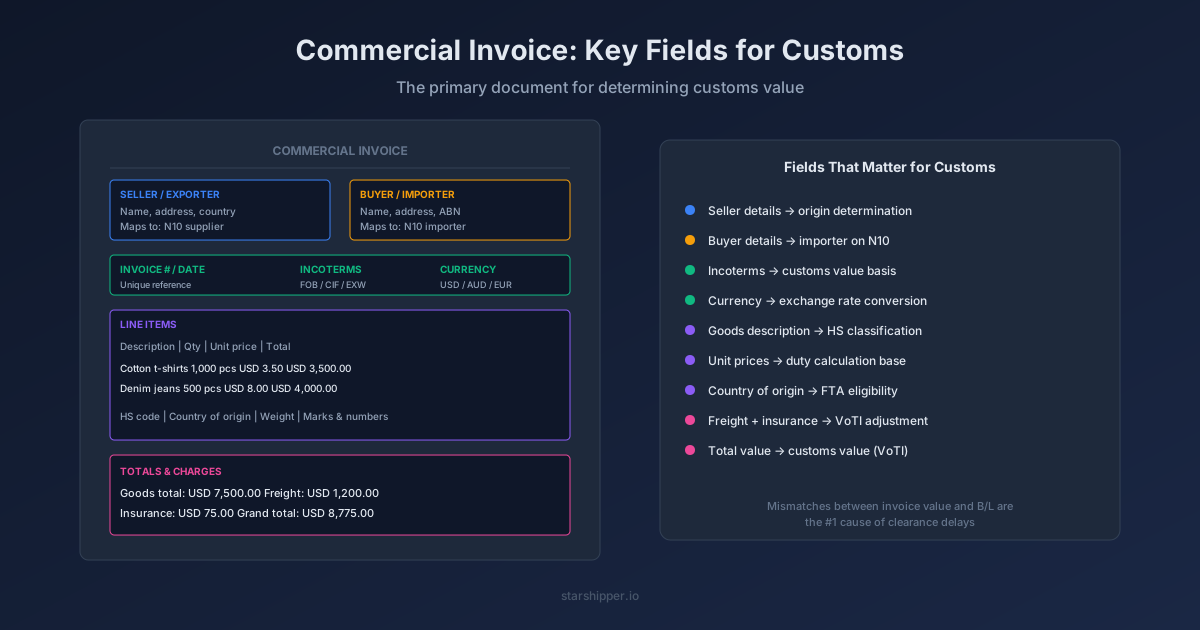
Seller and buyer details identify the parties to the transaction. The seller's name and address establish where the goods are coming from. The buyer's name and address should match the importer of record on the N10 import declaration. When these don't match, it raises questions about the transaction value and whether the sale was between related parties (which triggers a different valuation method under the Customs Act).
Invoice number and date are your reference points. The invoice number links the document to the rest of the shipment paperwork, and the date matters for exchange rate conversion. If the invoice is in US dollars, the Australian customs value is calculated using the exchange rate on the date of export, not the invoice date. But the invoice date helps establish when the transaction occurred and whether it aligns with the shipping timeline.
Description of goods needs to be specific enough that a customs officer can identify what's being imported and assign the correct tariff classification. "500 units of stainless steel kitchen sinks, model SK-400, 18/10 grade" works. "Assorted household items" does not. The description should match what appears on the packing list and bill of lading, even if the invoice version is more detailed. If you're unsure which HS code applies to a product, the invoice description is usually where classification starts.
Quantity and unit price are the building blocks of the customs value calculation. Each line item should show the number of units and the price per unit, with the line total extending across. For duty calculation, what matters is the total value of each tariff classification in the shipment. If you have 200 stainless steel sinks at $45 USD each and 100 ceramic basins at $30 USD each, those are two separate tariff lines with different duty rates. The invoice needs to break them out individually, not lump them together.
Total value and currency give you the headline figure that forms the basis of the customs value. The customs value is usually the transaction value, which is what you actually paid for the goods, converted to Australian dollars at the exchange rate on the day of export. If the invoice shows USD 22,500, that's the starting point. Whether that's the final customs value depends on the incoterms.
Incoterms (like FOB, CIF, CFR, or EXW) tell you what's included in the invoice price. This is critical for customs valuation because Australian customs assesses duty on the FOB value (Free on Board), which includes the cost of goods plus all charges up to and including loading onto the vessel at the port of origin. If the invoice is CIF (Cost, Insurance, Freight), you need to subtract the freight and insurance to get back to FOB. If it's EXW (Ex Works), you need to add inland transport to the port. The incoterm determines which direction you adjust. You can model the full calculation using our landed cost calculator.
Country of origin identifies where the goods were manufactured, grown, or substantially transformed. This is not necessarily where they were shipped from. Goods manufactured in Vietnam but shipped via a warehouse in Singapore still have Vietnam as the country of origin. The origin determines whether a preferential duty rate applies under a free trade agreement and whether any anti-dumping or countervailing duties are in effect.
HS codes, when they appear on the invoice, give you the supplier's suggested tariff classification. These are helpful as a starting point but should never be taken at face value. Suppliers often use their own country's tariff codes, which may not match the Australian Harmonized Tariff. The first six digits are internationally standardised, but the remaining digits are country-specific. Always verify against the Australian tariff schedule.
Payment terms (Net 30, Letter of Credit, TT in advance) don't directly affect customs valuation in most cases, but they establish the commercial nature of the transaction. An invoice with no payment terms, or with terms that don't make commercial sense, can trigger scrutiny from ABF about whether the transaction value is reliable.
Freight and insurance charges should appear on the invoice if the incoterm includes them. A CIF invoice should show the freight cost and insurance premium as separate line items or as a lump sum addition. If they're bundled into the unit price without being itemised, the customs value calculation gets murkier and you may need to request a freight invoice from the carrier to properly back out the components.
Common problems with commercial invoices
After processing thousands of invoices, certain problems come up repeatedly. Most of them cause delays at customs, not because the invoice is fraudulent, but because it's missing information that the declaration requires.
Missing incoterms is the most common issue. Without knowing the trade terms, you can't determine whether the invoice value includes freight and insurance or not. Customs defaults to treating the value as a transaction value, but if you can't demonstrate what's included, you may end up paying duty on a higher value than necessary. Or worse, under-declaring and facing a penalty later.
Vague descriptions like "assorted goods", "samples", or "personal effects" are a red flag. Customs needs specific descriptions to classify goods correctly. An invoice that says "machine parts" could cover hundreds of different tariff headings with duty rates ranging from zero to ten percent.
Values that don't match the bill of lading create reconciliation problems. If the invoice says 800 cartons at 12,000 kg and the B/L says 750 cartons at 11,200 kg, someone needs to explain the discrepancy before the declaration can be lodged. These cross-check failures are one of the biggest causes of clearance delays.
Missing country of origin means you can't claim preferential duty rates under an FTA, even if the goods would otherwise qualify. The invoice should clearly state where the goods were manufactured.
Wrong currency or missing exchange rate can throw off the entire valuation. An invoice that shows a total in euros but lists unit prices in US dollars needs clarification before the customs value can be calculated.
Commercial invoice vs proforma invoice
A proforma invoice is a preliminary document that the seller issues before shipment. It shows the expected goods, quantities, and prices, but it's an estimate, not a final bill. Importers often use proformas to arrange letters of credit, apply for import permits, or plan their logistics before the goods ship.
A commercial invoice is the actual billing document issued after (or at the time of) shipment. It reflects what was actually shipped, the real quantities, and the final agreed prices.
Customs requires the commercial invoice, not the proforma. Lodging an import declaration based on a proforma is a common mistake that leads to amendments later when the final invoice arrives with different quantities or values. If you only have a proforma at the time of clearance, you'll need to make a provisional declaration and correct it when the commercial invoice comes through, which adds cost and administrative overhead.
The practical test is simple: if the document says "Proforma Invoice" at the top, it's not the document you need for customs. Wait for the commercial version. If the goods have already arrived and you still only have a proforma, chase the supplier for the final invoice before lodging.
How document extraction works
Modern customs software reads commercial invoices and extracts the structured data automatically. The process works by scanning each page of the invoice (whether it's a PDF, scanned image, or email attachment), identifying the key fields listed above, and mapping them into the corresponding shipment record.
For invoices, the extraction captures seller and buyer names, addresses, ABNs (if present), line item descriptions, quantities, unit prices, HS codes, country of origin, incoterms, and totals. These values then populate the shipment record and feed into cross-checks against the bill of lading and packing list. When a field doesn't match across documents, you know about it before you lodge, not after. You can read more about that process in our guide on what documents you need to import goods into Australia.
The invoice is rarely the only document in a shipment, but it's the one that carries the most weight for customs valuation. Getting it right, and catching problems early, saves time at the border and money on duty.
See it work on your documents
Forward a commercial invoice or bill of lading to your StarShipper inbox — every field extracted and validated in seconds.